Affichage des articles dont le libellé est lesson. Afficher tous les articles

vendredi 1 mai 2020

QUEEN QUIZZ: CORRECTION

Voilà les réponses du quizz précédent. Soyez préparés prochainement à une classe virtuelle, je vous donnerai plus d'infos sur Pronote et sur le blog pour la date et l'heure.

WHAT DO YOU KNOW ABOUT THE QUEEN?

I/ QUIZZ:


1) How old is Elizabeth II?
a. 78
b. 87
c. 94

Elizabeth is the oldest monarch of England history!
In England, people celebrate a long reign with a celebration called a "Jubilee". For example, after 25 years of reign, there is a big parade for the "Silver Jubilee". Elizabeth II is the FIRST queen to celebrate a "Sapphire Jubilee" = 65 years of reign!
She beat the record of Queen Victoria (who reigned for 63 years).


2) What is the real title of Elizabeth II?
a. Queen of England, Scotland, Wales and Northern Ireland.
b. Queen of the United Kingdom and the other Commonwealth realms.
c. Queen of Great Britain and English Colonies.


Even if we call her "Queen of England", Elizabeth II is officially "Queen of the United Kingdom" (=England+ Scotland+ Wales+ Northern Ireland) and "the other Commonwealth realms". The CommonWealth is a world organisation with 54 countries who were all ex-colonies of the British Empire. They are not totally independent and free, but the Commonwealth is not really a political organisation, but more of a cultural and economic organisation. They also do sport competitions like the Commonwealth Games.


3) Elizabeth's coronation took place in 1953! It was special because...
a. She was the first woman to rule England.
b. It was the first televised coronation.
c. She was not married when it happened.

Elizabeth became queen at 25, which was very young. She incarnated modernity because her coronation was the first to be transmitted on national televisions. This was a BIG change because the coronation is a very sacred ceremony and "normal people" were not invited inside the church for the event. With television, the coronation was accessible for everyone and helped to "democratize" the British Monarchy.


4) What is the name of the House* of Elizabeth II? (*House= name of her family)
a. Tudor
b. Stuart
c. Windsor

Elizabeth is from the House of Windsor. She is a descendant of Queen Victoria, but the name of the house changed: Victoria is from the House of Hanover, of German origins. With the World Wars, they changed the name to "Windsor" (from the name of a royal castle) to be more "English".
The Stuarts were a Scottish dynasty who reigned on England for some time. 
The Tudors is another famous Royal House, with kings like Henry the 8th or...Elizabeth I ! She is the reason the current queen is called Elizabeth "2" !


5) One of these sentence is fake, which one?
a. Elizabeth is also Queen of Canada and Australia.
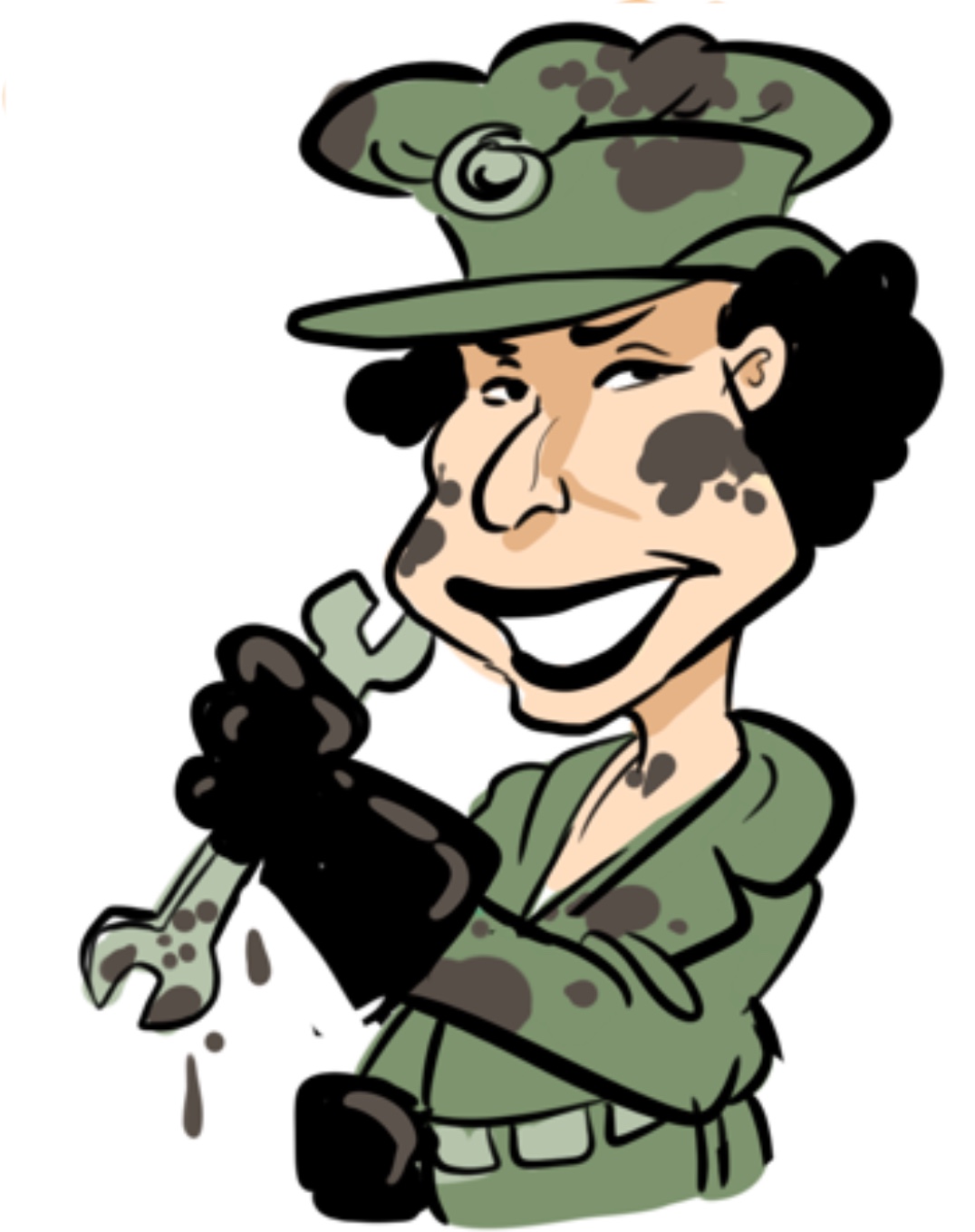
b. When she was young, Elizabeth worked as a mechanic in a car factory.
c. Elizabeth had three husbands during her reign.

- Elizabeth was always married to one man, Philip, Duke of Edinburgh. They are still married actually! 
- Yes, Elizabeth is technically Queen of Canada and Australia because these 2 countries are part of the Commonwealth (see question 2). 
- During World War 2, Elizabeth worked as a car mechanic (garagiste) and driver in the woman branch of the British Army in 1945 to show the support of the royal family for British people. 


6) What is the Queen's official residency?
a. 10 Downing Street
b. Hampton Court Palace
c. Buckingham Palace

Buckingham Palace is the official residency of the British Monarchs since Queen Victoria.
10 Downing Street is the official house the Prime Minister.
Hampton Court Palace was an old royal residency, mainly for Henry the 8th.


7) If Elizabeth II dies, who will the next king?
a. her husband, Philip.
b. her son, Prince Charles.
c. her grandson, Prince William.

Sorry guys, it's not going to be Prince William! 
Traditionally, only the first son (or daughter) of a king or queen can become the next one. 
BUT Prince Charles is already 71 years old, so there is the possibility he could decide he is too old and want to give the crown to his first son, William, maybe to make the monarchy look younger...we don't know!
We might have to wait longer because Elizabeth II is from a family where women live long: her mother died at age 101!


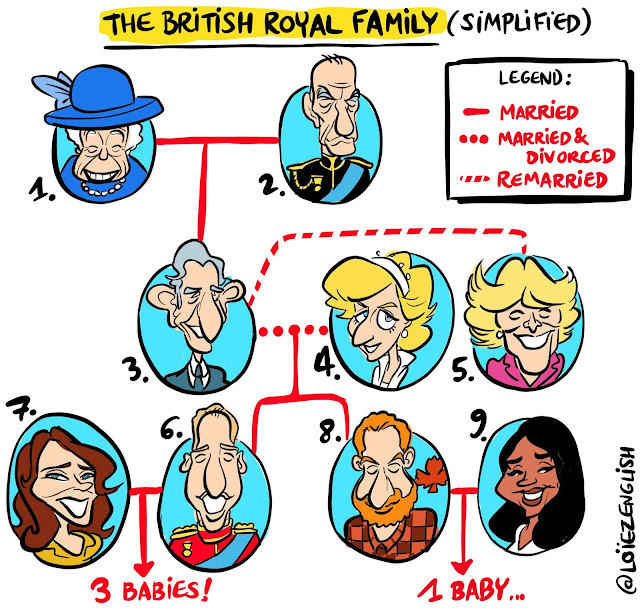
II/ FAMILY TREE: 

Answers:
1. Elizabeth II, Queen of England.
2. Prince Philip, Duke of Edinburgh (her husband).
3. Charles, Prince of Wales (her son).
4. Lady Diana, ex-Princess of Wales (she divorced Charles in 1996, and died in a car accident in 1997)
5. Camilla,  Duchess of Cornwall (Prince Charles's second wife).
6. Prince William, Duke of Cambridge (Prince Charles's first son)
7. Catherine (Cathy) Middleton, Duchess of Cambridge (Prince William's wife).
8. Prince Harry, Duke of Sussex (who left with his wife for Canada)
9. Meghan Markle, Duchess of Sussex (wife of Prince Harry).


dimanche 26 avril 2020

SEQUENCE 5: THE BRITISH ROYALTY!

Hello everyone, j’espère que vous avez passé de bonnes vacances (...enfin) et que vous et vos proches vous portez bien.
Nous entamons aujourd’hui une nouvelle séquence! Je me suis basé sur certaines de vos conversations en classe qui portaient sur les actualités des membres de la famille royale anglaise, et je me suis dit: pourquoi pas?
L’idée de cette séquence sera de vous faire découvrir et mieux comprendre l'existence de la famille royale britannique et surtout répondre à la question suivante:
"IS THE BRITISH ROYALTY STILL RELEVANT?"

"Relevant"= pertinent. La Monarchie Britannique a-t-elle encore une utilité aujourd’hui? Pourquoi les Britanniques ont-ils encore besoin d’un roi ou d’une reine? Vous avez peut-être déjà quelques idées de réponses, mais nous allons explorer cela petit à petit...


To start nicely, let's talk about some facts about the British Royal Family. You can try to answer yourself (in the comment section) or by searching on the Internet (you can!)

WHAT DO YOU KNOW ABOUT THE QUEEN?

I / QUIZZ

1) The question you always ask: how old is Elizabeth II?
a. 79 years old
b. 87 years old
c. 94 years old

2) What is the real title of Elizabeth II?
a. Queen of England, Scotland, Wales and Northern Ireland.
b. Queen of the United Kingdom and the other Commonwealth realms.
c. Queen of Great Britain and English Colonies.

3) Elizabeth's coronation took place in 1953! It was special because...
a. She was the first woman to rule England.
b. It was the first televised coronation.
c. She was not married when it happened.

4) What is the name of the House* of Elizabeth II? (*House= name of her family)
a. Tudor
b. Stuart
c. Windsor

5) One of these sentence is fake, which one?
a. Elizabeth is also Queen of Canada and Australia.
b. When she was young, Elizabeth worked as a mechanic in a car factory.
c. Elizabeth had three husbands during her reign.

6) What is the Queen's official residency?
a. 10 Downing Street
b. Hampton Court Palace
c. Buckingham Palace

7) If Elizabeth II dies, who will the next king?
a. her husband, Philip.
b. her son, Prince Charles.
c. her grandson, Prince William.


II/ FAMILY TREE:

Here is a very simplified family tree of the Windsor Royal Family (simplified because I didn't put everyone!). Try to find on Internet the name (and titles) of the different members:


1. Elizabeth II, Queen of England.
2.
3.
4.
5.
6.
7.
8.
9.

III/ PERSONAL OPINION: (1 or 2 sentences)

Do you think kings and queens should be a thing of the past or should they still exist? Why?

lundi 6 avril 2020

RESUME DE LA SEQUENCE 4

C’est quasiment la fin de cette séquence sur la musique Afro-Américaine et je souhaitais transformer en jeu un petit résumé des différents styles de musique - que j’ai pris de le temps de dessiner pour vous. Répondez dans la section commentaire, même si vous n’êtes pas sûr(e)s ou si vous n’avez pas tout trouvé.


You have to find the name of different styles of African-American music. 
- The number of strokes (traits) corresponds to the number of letters. 
- They can be 1 or 2 words. 
You can answer in the comment section !


ANSWER: _ _ _ _ _


ANSWER: _ _ _ _     _ _ _ _

ANSWER: _ & _ 

ANSWER: _ _ _ _ _   _ _ _ _

ANSWER: _ _ _ _ 

ANSWER: _ _ _   _ _ _

ANSWER: _ _ _ _ _

ANSWER: _ _ _ _ _ _

ANSWER: _ _ _ _ 


ANSWER: _ _ _ _ _ _ _

lundi 23 mars 2020

SPOKEN ENGLISH

SEQUENCE 4: AFRICAN-AMERICAN MUSIC

Je vous avais envoyé sur Pronote ce document avec les questions (en italiques) sans réponse. Je remercie ceux qui l'on fait, et je comprends ceux qui l'ont vu trop tard. Dans tous les cas, voici le document corrigé, avec les réponses.Pour revoir le texte d'origine, "The Weary Blues", cliquez ici.Pour un petit florilège de chansons avec l'expression "Ain't", cliquez ici !

SPOKEN ENGLISH


1) The part in yellow is very particular. Why is it different from the rest of the text? (Look at the punctuation!):
It is direct speech. It is the Blues song that the pianist is singing, because it is between quotation marks (guillemets). 


2) This part is written in oral English so there are a lot of contractions symbolized by the apostrophes ( ’s ). To understand it, you need to find the original complete word (for example, I’m = I am)


Frownin’ = frowning (froncement de sourcils)
No mo’   = no more (ne...plus)


3) Sometimes words are written differently because of the pronunciation: can you understand:


Ma self: myself
Ma troubles: my troubles


4) Ain’t is used a lot in modern English, do you know its meaning? (Help: what is the complete version of “n’t’’ ? )


Ain’t = not
PETITE REMARQUE CULTURELLE: AIN’T

Pour ceux qui regardent des séries américaines ou qui écoutent du rap américain, vous êtes sans doute déjà tombés sur “ain’t”. Il s’agit d’une expression négative qui existe depuis longtemps comme une variante du “not”, mais au fur et à mesure des siècles elle a commencé à être associée à une forme de négation vulgaire qui reflèterait un manque d’éducation et une classe sociale basse. C’est pour ça qu’elle est encore assez rare à l’écrit. 

Il est vrai que c’est une expression de facilité pour s’exprimer parce qu’elle a plusieurs utilisations: “ne pas être” (not to be) = I ain’t stupid (je ne suis pas stupide), ou encore ne pas avoir (to not have) = I ain’t got time for this (je n’ai pas de temps pour ça).

A cause de ces stigmatisations, “ain’t” est devenue une marque d’expression des minorités ethniques, y compris donc de la communauté afro-américaine aux Etats-Unis. Dans notre texte, le poète Langston Hughes utilise un anglais courant pour la majorité du texte, puis utilise ces marques d’oralités typiques quand il fait parler le pianiste.

5) “I’s gwine to”is very complicated to understand because it is very deformed from the real expression. Help: try to say it out loud (dites le à voix haute) to understand the real spelling (orthographe)


I’s gwine to = I’m going to ( futur proche : je vais + verbe)


Là vous vous demandez peut être pourquoi le I’s devient un I’m: en réalité, Langston Hughes montre encore la langue anglaise des minorités ethniques qui n’observe pas les règles habituelles de la conjugaison: vous qui apprenez vos conjugaisons par coeur, vous savez que l’on dit “I am”, sauf que le pianiste ici dit “I is”, ce qui est incorrect, mais qui correspond à la réalité de l’époque…

Gwine to pour “going to” est très déformé orthographiquement. Vous êtes peut-être plus familiers avec l’expression plus moderne de “I’m gonna” pour dire la même chose.

J’en profite pour rappeler que si toutes ces marques d’oralités sont importantes à apprendre pour comprendre l’anglais oral, il ne faut pas utiliser ce genre de contractions dans les examens écrits (je vois peu de “gonna” heureusement dans vos copies, mais je vois beaucoup de “‘cause” au lieu de “because”, ce qu’il faudrait éviter).

6 ) Now you can translated the yellow part on your page!


“Ain’t got nobody in all this world,
Ain’t got nobody but ma self.
I’s gwine to quit ma frownin’
And put ma troubles on the shelf.”
“I got the Weary Blues
And I can’t be satisfied.
Got the Weary Blues
And can’t be satisfied—
I ain’t happy no mo’
And I wish that I had died.”

Je n’ai personne dans ce monde,
je n’ai personne d’autre que moi-même.
Je vais quitter mon froncement de sourcils ( = ma colère)
Et mettre mes problèmes sur l’étagère (= de côté)
J’ai le Blues Las
Et je ne peux pas être satisfait.
J’ai le Blues Las
Et je ne peux pas être satisfait.
Je ne suis plus heureux
Et j’aurais préféré être mort.

Bien sûr, on aurait pu imaginer une version française avec des marques d’oralités: j’ai personne dans c’monde, j’peux pas, j’suis plus, j’ai l’Blues, etc…

"THE WEARY BLUES" by Langston Hughes

SEQUENCE 4: AFRICAN AMERICAN MUSIC

DOC 2: Poem : "THE WEARY BLUES" by Langston Hughes (1925)

Voici le texte que nous avons déjà étudié en classe pour apprendre à traduire avec et sans Internet. Pour la leçon sur la partie en jaune pour l'anglais oral, cliquez ici.Pour savoir qui était Langston Hughes, cliquez ici.


Original art by Miguel Covarrudias (1926)

THE WEARY BLUES

Droning a drowsy syncopated tune,
Rocking back and forth to a mellow croon,
I heard a Negro play.
Down on Lenox Avenue the other night
By the pale dull pallor of an old gas light
He did a lazy sway. . . .
To the tune o’ those Weary Blues.
With his ebony hands on each ivory key
He made that poor piano moan with melody.
O Blues!
Swaying to and fro on his rickety stool
He played that sad raggy tune like a musical fool.
Sweet Blues!
Coming from a black man’s soul.
O Blues!
In a deep song voice with a melancholy tone
I heard that Negro sing, that old piano moan—
“Ain’t got nobody in all this world,
Ain’t got nobody but ma self.
I’s gwine to quit ma frownin’
And put ma troubles on the shelf.”

Thump, thump, thump, went his foot on the floor.
He played a few chords then he sang some more—
“I got the Weary Blues
And I can’t be satisfied.
Got the Weary Blues
And can’t be satisfied—
I ain’t happy no mo’
And I wish that I had died.”
And far into the night he crooned that tune.
The stars went out and so did the moon.
The singer stopped playing and went to bed
While the Weary Blues echoed through his head.
He slept like a rock or a man that’s dead.

Langston Hughes, The Weary Blues, 1925